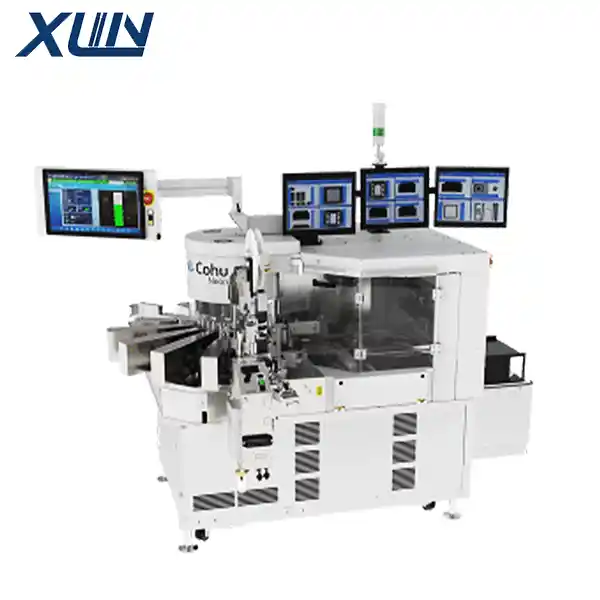
 The Cohu Ismeca Neon is a turret-style, tri-temperature test handler from Cohu (under its Ismeca brand). It is designed to perform high-speed electrical testing and tape-and-reel output for small and ultra-small packaged devices within a compact footprint—a capability particularly well-suited for applications such as automotive electronics, which require testing across a wide temperature range.
Core Architecture: Turret + Tri-Temperature
The Neon utilizes a turret architecture, where devices are held by nozzles on a rotating disk. As the disk turns, components pass sequentially through test, vision, and taping stations, enabling a continuous, high-throughput workflow. A key differentiator from standard consumer-grade handlers is its tri-temperature capability: it supports cold, ambient, and hot testing, covering a range from -55°C to +150°C (extendable to +175°C in certain configurations), thereby meeting the tri-temperature testing requirements for automotive-grade components.
Throughput and Package Compatibility
In terms of throughput, the turret design allows the Neon to achieve high processing rates for small devices; the exact units-per-hour (UPH) figure varies based on the specific configuration and test duration. The system supports a wide array of small and ultra-small packages, including SOT, SOD, QFN, DFN, MEMS, and LEDs. It accommodates various input formats—such as bulk, tubes, or trays—and delivers finished components in tape-and-reel format. Integrated vision inspection typically covers mark, orientation, pin, and bottom-pad checks, allowing for the detection of visual defects before or after the electrical test.
Positioning within the Product Family
Within the Ismeca product portfolio, the Neon—like the NY series (e.g., NY20, NY32)—is a turret-style, tri-temperature handler. However, the Neon is specifically positioned for a compact footprint and flexible configuration tailored to certain package segments. For production lines requiring higher parallelism or support for a broader range of package sizes, the NY series serves as a higher-capacity alternative. Conversely, for applications focused on small discrete components and sensors—where floor space is a critical constraint—the Neon’s turret architecture and tri-temperature functionality offer a highly practical solution within its size class.