English
 南非荷兰语
 契维语
 阿姆哈拉语
 阿拉伯语
 阿萨姆语
 艾马拉语
 阿塞拜疆语
 白俄罗斯语
 保加利亚语
 孟加拉语
 波斯尼亚语
 加泰罗尼亚语
 宿务语
 科西嘉语
 捷克语
 威尔士语
 丹麦语
 de
 迪维希语
 希腊语
 英语
 爱沙尼亚语
 波斯语
 芬兰语
 爱尔兰语
 瓜拉尼语
 豪萨语
 希伯来语
 苗语
 克罗地亚语
 海地语
 匈牙利语
 亚美尼亚语
 印尼语
 冰岛语
 意大利语
 日语
 格鲁吉亚语
 高棉语
 韩语
 库尔德语
 吉尔吉斯语
 拉丁语
 卢森堡语
 卢干达语
 林加拉语
 老挝语
 立陶宛语
 拉脱维亚语
 毛利语
 马其顿语
 马来语
 马耳他语
 缅甸语
 尼泊尔语
 荷兰语
 挪威语
 齐切瓦语
 波兰语
 普什图语
 葡萄牙语
 罗马尼亚语
 俄语
 卢旺达语
 信德语
 僧伽罗语
 斯洛伐克语
 斯洛文尼亚语
 萨摩亚语
 索马里语
 阿尔巴尼亚语
 塞尔维亚语
 瑞典语
 斯瓦希里语
 塔吉克语
 泰语
 提格利尼亚语
 土库曼语
 土耳其语
 乌克兰语
 越南语
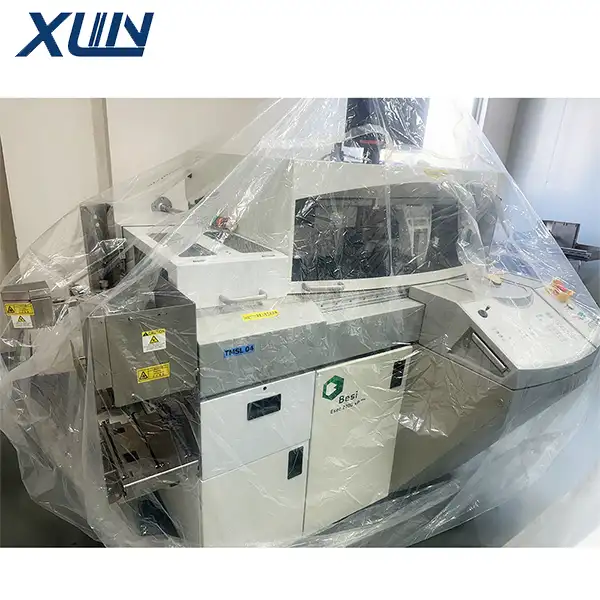
Besi Esec 2100 xPplus High-Speed Epoxy Die Bonder
Product Detail
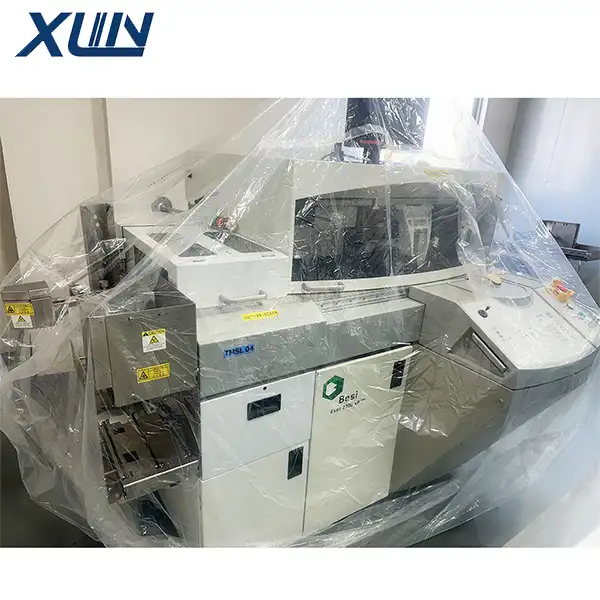 The Besi Esec 2100 xPplus is a high-speed epoxy die bonder from Besi’s 2100 series. It is primarily designed for high-volume production using 300mm-long lead frames and a wide variety of package types. It achieves an optimal balance between speed and precision through its revolutionary "Phi-Y" pick-and-place mechanism—an innovation that earned the platform a Swiss Technology Award upon its release.
Core Performance: The Phi-Y Pick-and-Place Mechanism
The system’s standout technical feature is the Phi-Y pick-and-place mechanism, which integrates rotational and linear motion, replacing the traditional three-stage angular displacement path. Combined with a rigid, symmetrical bonding head and vibration compensation, this system reduces the pick-and-place cycle time to 167 ms. It offers a standard placement accuracy of 20 µm @ 3σ, with an optional high-precision mode that improves accuracy to 15 µm @ 3σ.
Process Compatibility and Specifications
The equipment supports wafers ranging from 4 to 12 inches and accommodates die sizes from 0.25 mm (requiring a small-die kit) up to 20 mm. It handles lead frames with lengths between 90 and 300 mm and widths between 9 and 84 mm. It is suitable for epoxy-based die bonding across a diverse range of package types, including QFN, TSOP, QFP, BGA, CSP-BGA, SiP-BGA, FBGA, and LGA.
Summary
The Besi Esec 2100 xPplus is an epoxy die bonder centered on the high-speed Phi-Y pick-and-place mechanism. It combines 15 µm-class precision with broad package compatibility, emphasizing high throughput and ease of product changeover for 300mm-substrate production environments. Most units of this model currently found on the market are pre-owned (second-hand) equipment.